
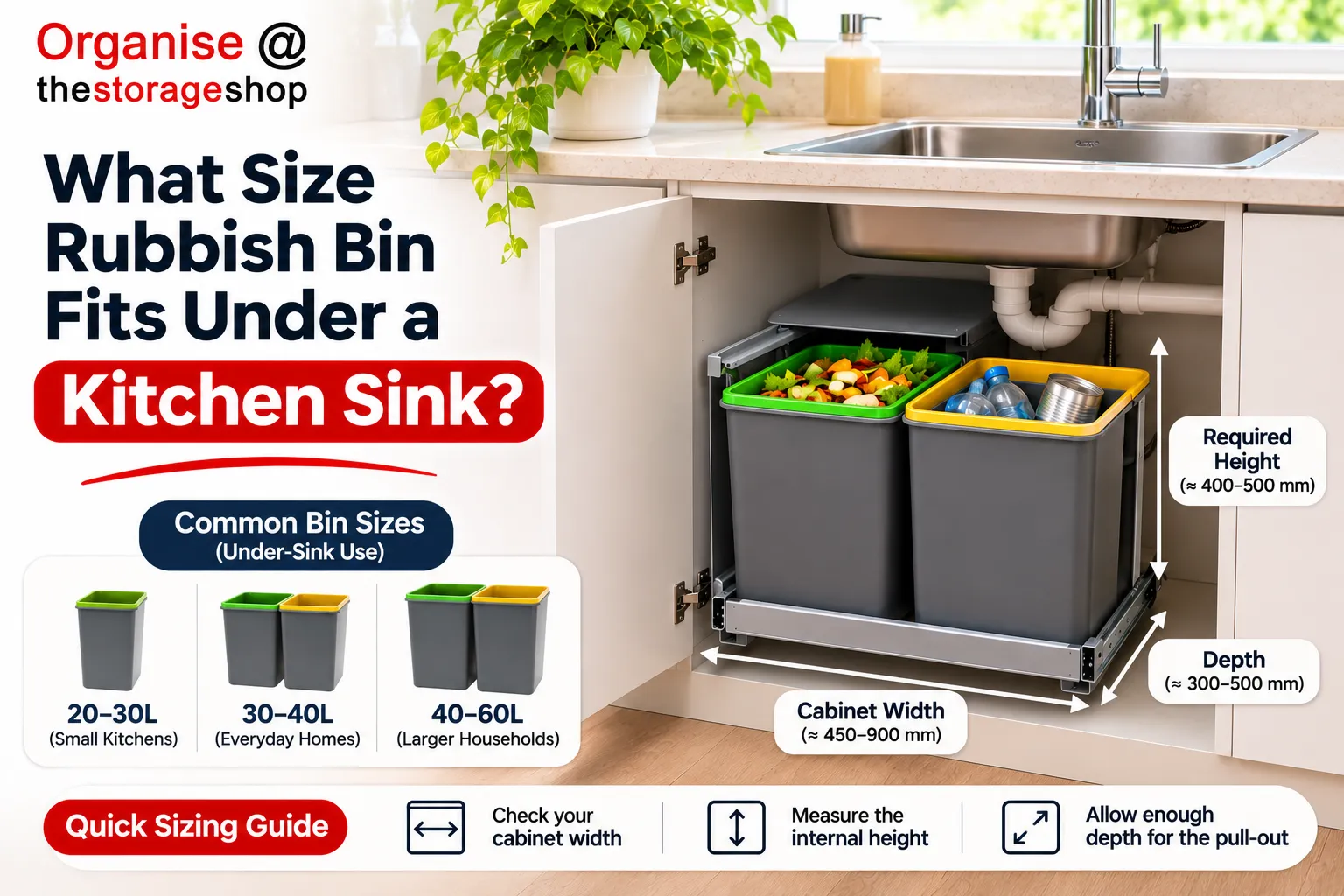
Short answer: Most under sink rubbish bins hold between 15 and 40 litres. A narrow 300 mm sink cupboard usually takes up to about 34 litres, while a wider 400–450 mm cupboard with good clearance can fit a double system of 50–64 litres. The pipes decide the size more than the cupboard does, so measure around them first.
The sink cupboard looks like the obvious place for a bin, until you open the door. There’s a waste trap in the middle, two hoses at the back, a pair of taps, and a collection of spray bottles that has been growing for years. The space you actually have is often half what the cupboard suggests.
Here’s how to work out what fits, and which size suits your household.
Measure first, shop second
Choosing kitchen rubbish bins for the sink cupboard comes down to four measurements. Write them down before you look at a single product.
1. Internal width
Measure between the inside faces of the side panels, not the cabinet size on the plan. Panels are usually 16 mm thick, so a 450 mm cabinet is about 418 mm inside, and a 300 mm cabinet is around 268 mm.
2. Clear height under the trap
Measure from the cupboard floor to the lowest point of the waste pipe or trap. This is the number that rules out the most bins. Allow a little extra if the bin has a lid that lifts as it opens.
3. Usable depth
Measure from the back of the closed door to the back panel, or to the first pipe or hose in the way. A pull out frame needs this full depth, plus room for the door to clear it.
4. Gaps between the pipes
Some bins fit beside the trap rather than under it. Note how much room there is on each side of the waste pipe, and where the hoses and isolation taps sit.
Before you buy, check:
-
internal width, depth and clear height
-
where the trap, hoses and taps sit
-
whether the hinges stick out into the opening
-
whether there’s room left for the cleaning products that live there
What fits each cupboard width?
Under sink bins come in sizes for standard cabinet widths. As a rough guide:
|
Sink cupboard width |
Typical under sink bin capacity |
Common setup |
|
300 mm |
About 5–34 litres |
Single bin, or a slim double |
|
400 mm |
About 10–64 litres |
Single or double pull out |
|
450 mm |
About 15–60 litres |
Double pull out or swing-out |
These are capacities, not guarantees. Two 30-litre bins can have completely different heights, so always compare the product’s own minimum cabinet dimensions with your measurements.
Which size suits your household?
-
Single person or couple: 15–25 litres is usually enough if you empty it every few days.
-
Small family: 30–40 litres, ideally split into two buckets so recycling has its own space.
-
Larger family sorting recycling and food scraps: 50 litres or more over two buckets. Or keep a small food-scraps bin under the sink and put the main bin in another cupboard.
Look at bucket sizes as well as the total. A 40-litre double is two 20-litre buckets. If your recycling already goes in a separate crate, a single 30-litre bin might actually hold more of your everyday rubbish.
Which types of bin fit under a sink?
Low pull out bins
A frame on runners screws to the cupboard floor, and the buckets slide forward once the door is open. These are made low to clear the trap, and many come as doubles for rubbish and recycling. If the plumbing leaves enough height, this is the most practical option.
Swing-out door bins
A small bin, usually 5 to 20 litres, hangs inside the hinged door and swings out as it opens. It suits food scraps and cramped cupboards where a frame won’t fit. Check the hinge position and door strength first.
A simple in cupboard rubbish bin
When the plumbing is awkward, a basic in cupboard rubbish bin that sits on the floor beside the trap can be the answer. It’s not as convenient as a pull out, but it fits spaces nothing else will. If you’d rather keep the sink cupboard for cleaning gear, a pull out bin in the neighbouring cabinet is often the better move. Compare sizes in the in cupboard rubbish bin range.
Mistakes that lead to returns
-
Buying by litres alone. Capacity says nothing about height, and height is usually the problem under a sink.
-
Measuring the cabinet, not the inside. Those 16 mm side panels catch out plenty of people.
-
Forgetting the hinges. Some hinges sit far enough into the opening to block a frame.
-
Ignoring the damp. Sink cupboards collect drips. Choose removable plastic buckets, and check the tap connections now and then.
-
Overfilling the space. If the bin is jammed against a hose, every pull puts strain on the plumbing. Leave a little breathing room.
Frequently asked questions
Can a 40-litre bin fit under a kitchen sink?
Often, yes, in a 400 mm or wider cupboard with enough clear height under the trap. In a 300 mm cupboard, 30–34 litres is usually the limit.
What’s the smallest useful under sink bin?
Swing-out door bins start at around 5 litres. That’s enough for food scraps if you empty them daily.
Single or double bin under the sink?
A double if the space allows and you recycle at home. A single if the pipes leave limited height, or if your recycling lives somewhere else.
The bottom line
The right under sink bin is the biggest one that fits around your plumbing without a struggle, not the biggest one on the shelf. Measure the internal width, the clear height under the trap and the depth to the first obstruction, then match those numbers to the bin’s minimum sizes. Get that right, and the bin will slide out smoothly for years.
